Framing an AI experience around user needs
Bringing structure to an open-ended AI opportunity, from research synthesis to prompt design.
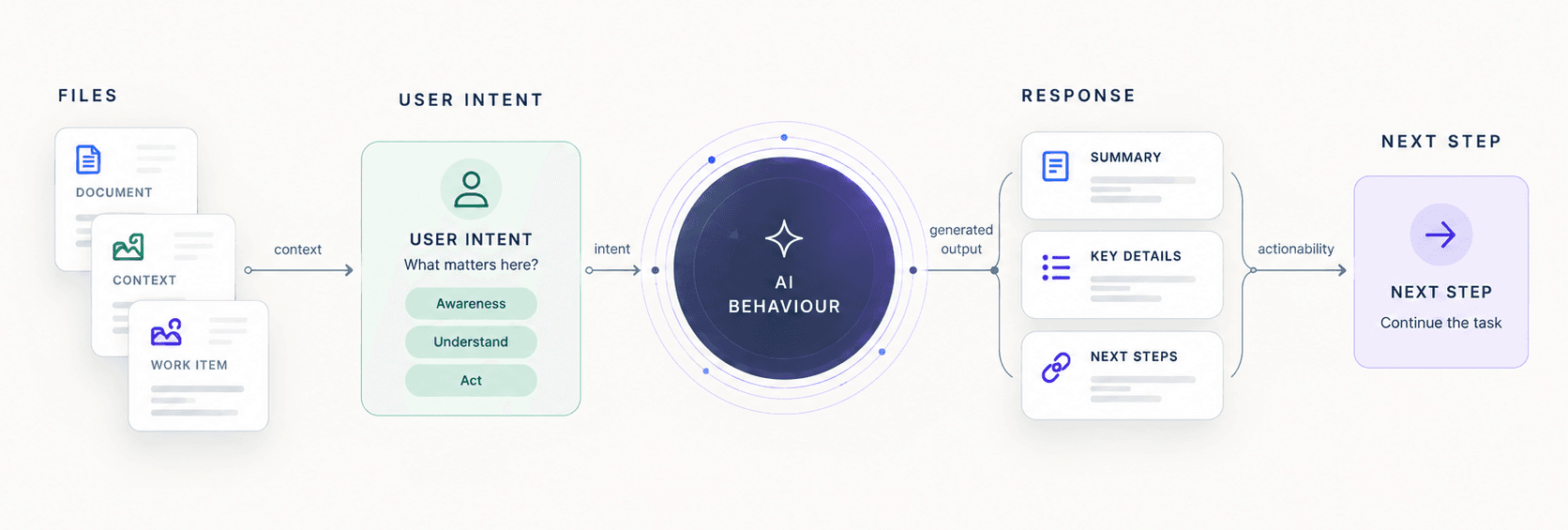
The challenge
Working with files is rarely just about finding the right document. People also need to understand what requires attention, make sense of context and decide what to do next.
The opportunity was broad: how might an AI-powered file experience reduce that cognitive overhead without simply adding another layer of complexity?
My role was to help the team bring structure to that ambiguity, first by building a shared understanding of the problem, then narrowing the opportunity around meaningful user jobs, and finally translating those jobs into a systematic approach to prompt design.
01. Creating a shared understanding
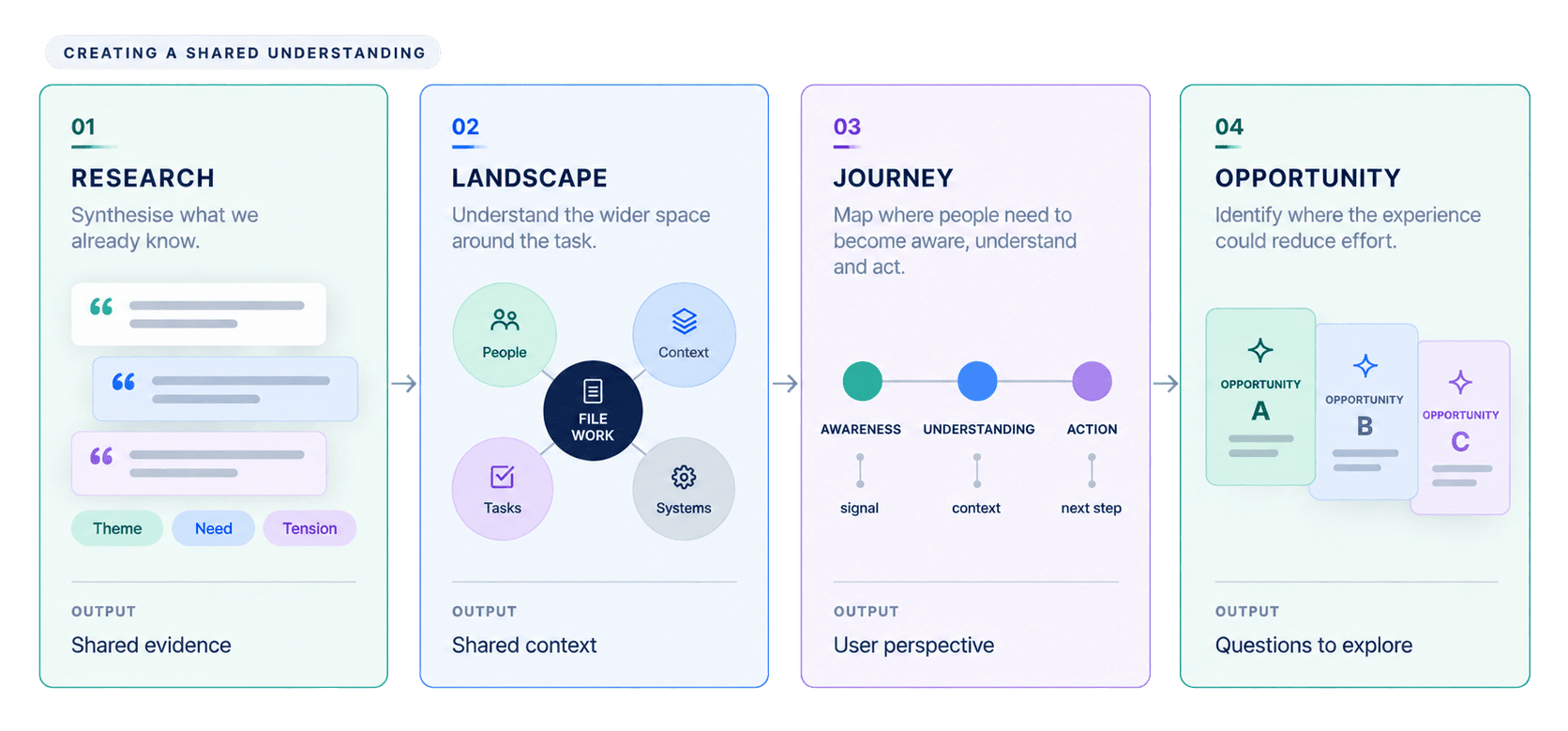
I started by synthesising existing research and mapping the broader journey around working with files.
I then brought product and engineering partners together for a working session where I shared the research themes, a high-level landscape review and an initial journey map.
The goal wasn't to present a solution. It was to give the team a common foundation for thinking about the opportunity before we started generating ideas.
What this enabled
- A shared view of the problem space
- Alignment around user needs rather than individual features
- Clearer questions for the team to explore together
02. Exploring the opportunity together
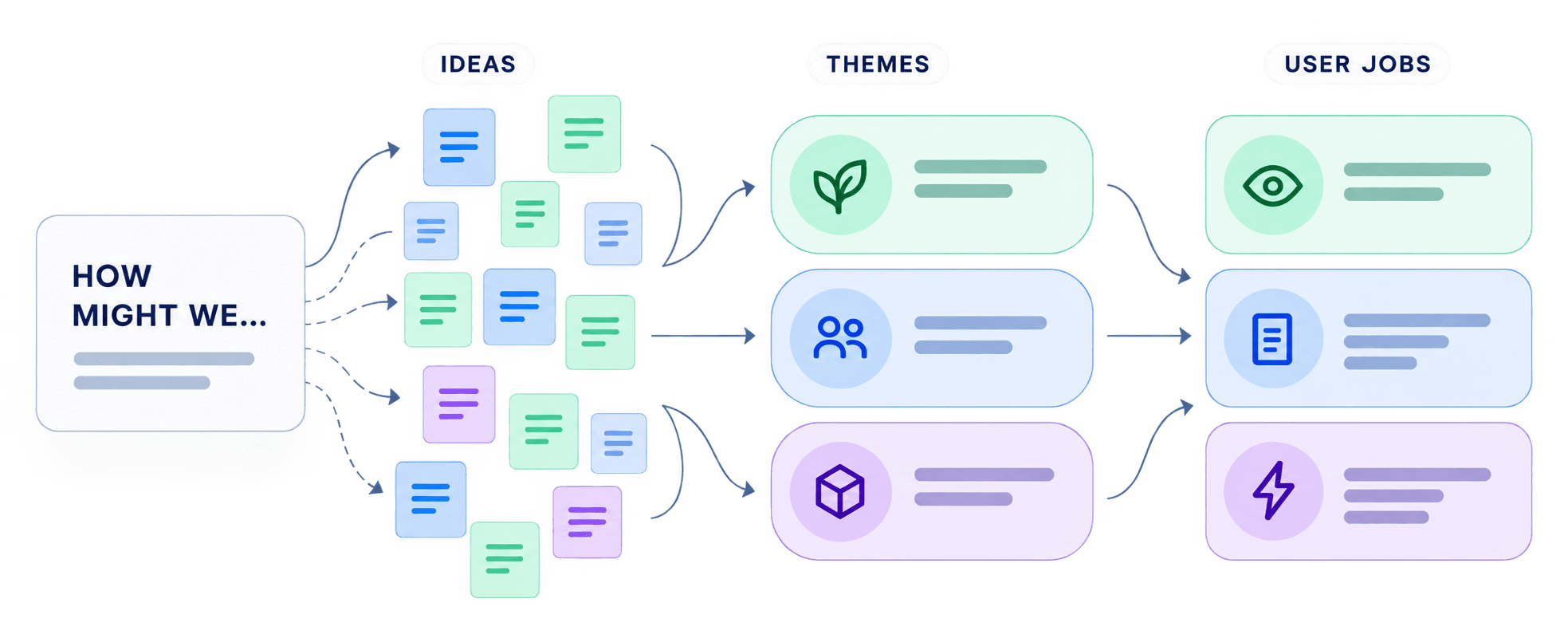
With that shared foundation, I facilitated a broader brainstorming session with the team.
We translated the research into How Might We questions and used those to deliberately widen the solution space. Rather than evaluating ideas too early, the goal was to understand the range of ways AI might support people's existing workflows.
Next, we clustered related ideas and looked for recurring patterns.
This created an important shift:
We moved from asking “What could the agent do?” to “What are people actually trying to accomplish?”
03. Moving from ideas to user jobs
The themes gave us direction, but they still described a solution space.
I wanted a framework that could survive beyond any individual concept, so I reframed the work around the underlying jobs users were trying to accomplish.
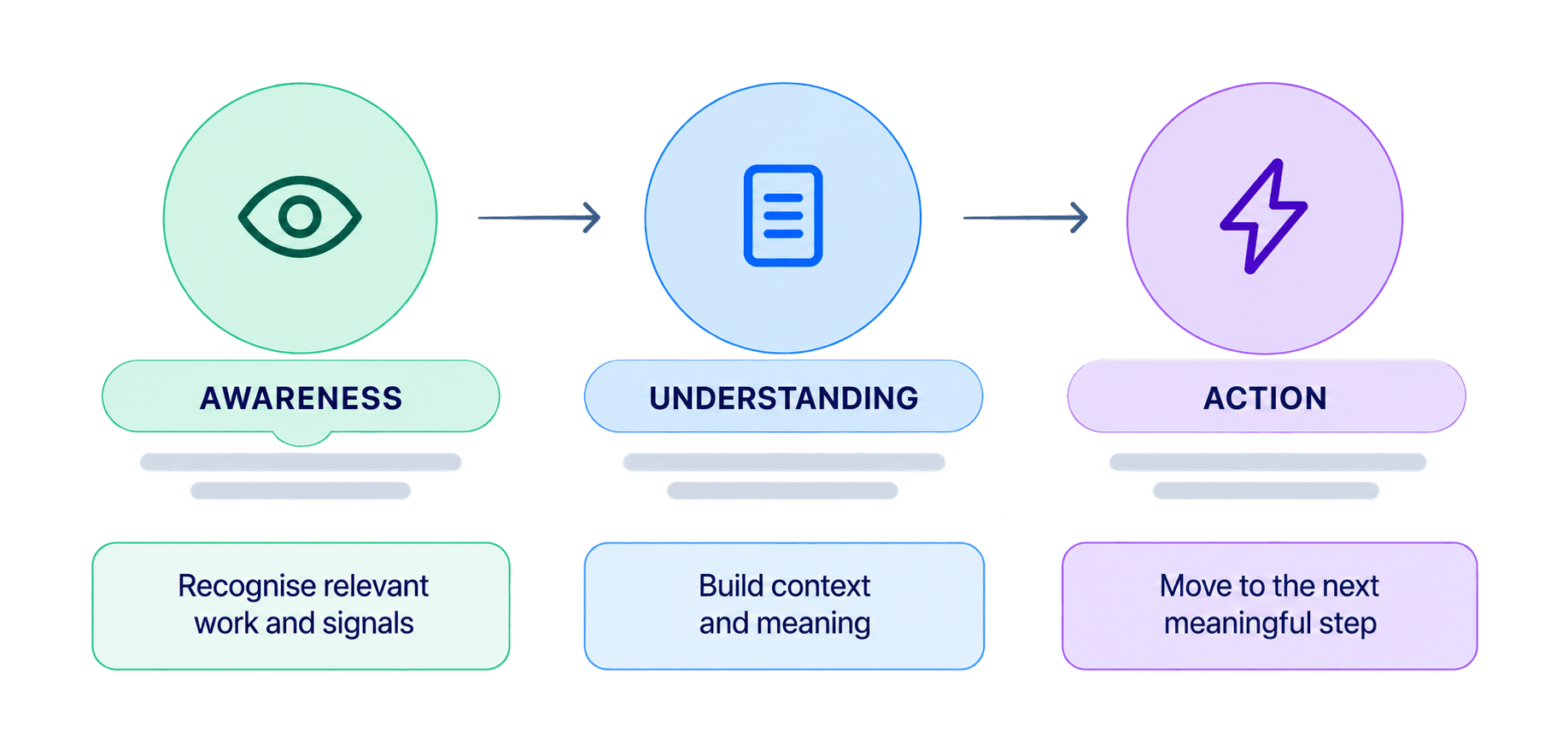
The journey ultimately organised around three broad moments:
Awareness - What needs my attention?
Help people recognise relevant work without manually reconstructing everything happening around their files.
Understanding - What do I need to know?
Help people quickly build enough context to understand why something matters.
Action - What should I do next?
Help people move naturally from understanding into the next meaningful step.
This became a simple lens for evaluating ideas and discussing priorities across disciplines.
04. Turning user jobs into a prompt-design framework
Once the user jobs were clearer, a new design question emerged:
How do we make the AI's behaviour respond to the user's context and intent, rather than designing a collection of generic prompts?
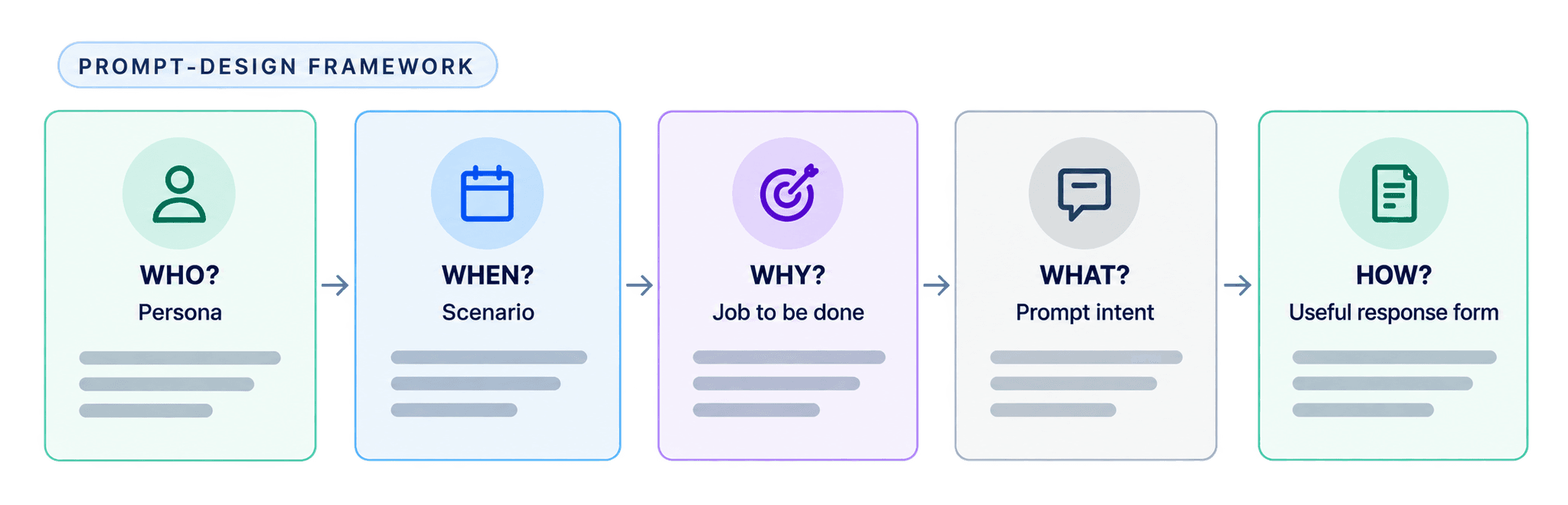
I created a framework connecting five layers:
Persona → Scenario → Job to be done → Initial prompt → Follow-up experience
Instead of starting with “What prompts should we provide?”, I started with:
- Who is the user in this situation?
- What context brought them here?
- What are they trying to accomplish?
- What should they be able to ask the AI?
- What form of response would best help them continue the task?
For example, someone responsible for coordinating work may need a very different response from someone who simply needs to understand what a document contains.
The framework therefore considered not only what the AI should communicate, but also how the information could be structured to match the job, such as concise summaries, task-oriented information or structured representations.
Why this mattered
It moved prompt design away from a list of clever example prompts and towards a systematic model for designing AI interactions around user intent.
05. Treating AI behaviour as interaction design
Working through the framework changed how I thought about the design material itself.
In a conventional interface, I might primarily control layout, hierarchy and interaction. In an AI experience, the generated response is also part of the interaction.
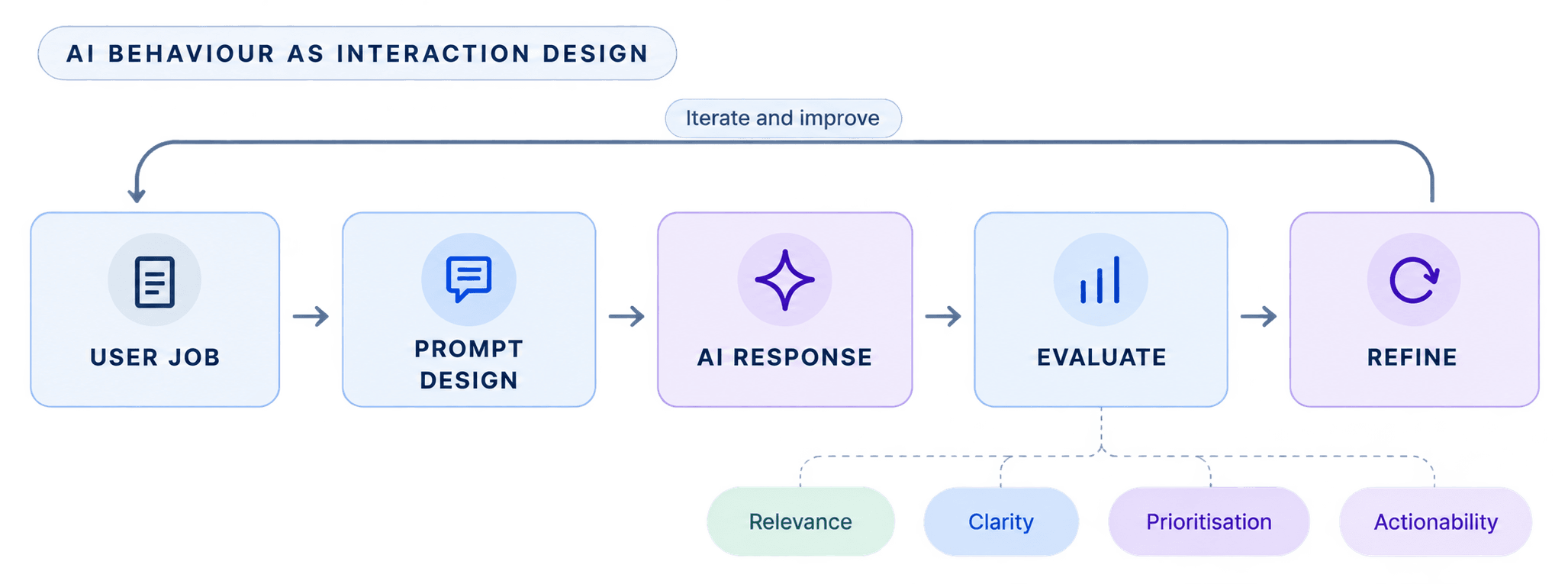
So my work expanded into designing and refining prompts, then reviewing generated responses to understand whether they aligned with the intended user job.
I looked at questions such as:
- Is the response relevant to the user's intent?
- Is important information prioritised?
- Is the answer understandable without unnecessary effort?
- Does its structure suit the task?
- Does it give the user a useful way forward?
I used those observations to refine the prompt and repeat the evaluation.
06. What I contributed
The most meaningful outcome of this work wasn't a single screen.
It was helping create structure for a product space that initially had many possible directions.
My contribution spanned:
- Synthesising research into an initial product framing
- Bringing product and engineering into the framing process early
- Facilitating divergent ideation before converging on themes
- Turning themes into durable user jobs
- Creating the Awareness → Understanding → Action journey model
- Developing a prompt-design framework grounded in persona, scenario and user intent
- Treating AI-generated responses as something that could be intentionally designed and evaluated
Reflection
With AI products, the interface is only part of the experience.
The project expanded my definition of product design.
Designing an AI-powered experience meant thinking about the relationship between user intent, context, system behaviour, generated responses and interaction, not just the screens surrounding them.
It also reinforced something broader about my practice: when a problem space is ambiguous, my highest-leverage contribution isn't always producing the solution first.
Sometimes it's creating the framework that helps a team understand the problem, evaluate possibilities and make better product decisions.